
Guide
When the Power Cuts Out, Your Opener Is the Weak Link
Old Bridge homes built between 1938 and 2005 pair aging openers with a cold winter grid. Here's what fails first when the power drops and the temperature does too.
Local detail
What to Check
Start with the manual release cord - the red handle hanging from the trolley. If you've never pulled it, do it once now, in daylight, so you're not fumbling with a flashlight during an outage. On homes built in the 1960s and 70s, which is most of the stock around here per F2, the opener has often been swapped once already but the release mechanism rarely gets inspected.
Next, check whether your opener has a battery backup. Units installed before battery backup became standard (common in houses from the 1965 median build era, F1) won't hold the door up or down when the power drops. If your opener predates 2010 or so, assume no backup.
Last, check the wall station wiring where it meets the ceiling unit. In older houses this run was added after the fact, stapled along a joist, and it's the first thing to work loose when a garage door gets manually forced open during an outage because someone didn't know about the release cord.

The area
What Most People Get Wrong
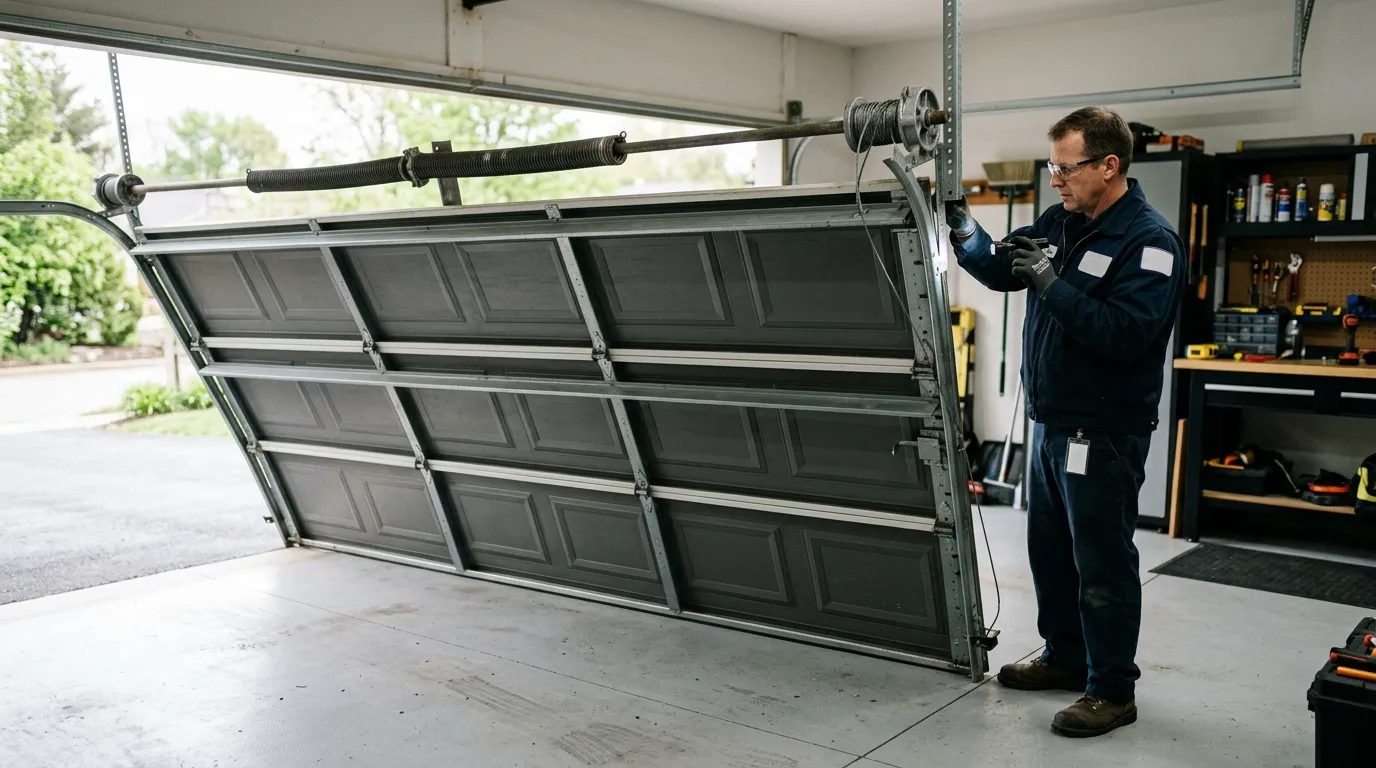
People assume a dead opener means a dead motor. Most of the time during a power cut it just means the door is doing exactly what it's built to do - nothing - because there's no power to the circuit board, not because anything broke. The mistake is forcing the door up by hand without pulling the release cord first. That bends the arm bracket or strips the trolley, and now you've turned a power company problem into a repair bill.
The other common error: leaving a garage door manually released and unlocked for days after an outage because nobody remembers to reconnect it once power's back. On a house from the older end of the 1938-2005 build range, the door often doesn't have a separate deadbolt, so an opener left disengaged is the only thing standing between the garage and the street.
A smaller thing, but it matters: people replace the opener when the real problem is the outlet or breaker it's plugged into. Test the outlet with something else before you assume the unit itself is shot.
What we find
What the Weather Here Does to It
This area sits in a cold-severe climate band, and cold does two things to openers that heat doesn't. First, it stiffens the grease in the drive mechanism, which makes the motor pull harder on startup - right when a winter storm is also more likely to knock out power. Second, cold makes circuit boards and capacitors fail at a higher rate than in a mild climate, so an opener that's marginal in October can quit outright on the first hard freeze.
Combine that with a power cut during the same storm and you get the worst version of this problem: a door frozen half-open because the motor tripped mid-cycle when the outage hit, and no battery backup to finish the job or hold position. On the older homes in this area (median build 1965, per F1), the openers were never spec'd for battery backup at all, so a winter outage just stops the door wherever it happens to be.
How we work
What Is Going On
Across this service area, most garage doors are paired with openers on houses built between 1938 and 2005, and the bulk of that stock dates to the 1960s and 70s. That means a lot of original or first-replacement openers that were never designed with battery backup or surge protection in mind, going into a cold-severe climate where hard freezes and the outages that come with winter storms happen in the same season.
The honest limitation here: we don't stock every opener board or capacitor on the truck, especially for older models that are getting harder to source. If your unit is old enough that the manufacturer's stopped making parts for it, replacement is usually faster and cheaper than tracking down a board. We'll tell you straight which one you're looking at before we start any work.
Questions
Common questions
Will my garage door opener work at all during a power cut?
Only if it has a battery backup, which many openers installed on older Old Bridge-area homes don't have. Without one, the opener won't move the door until power's restored. You can still open it manually using the release cord.
Does cold weather make power cuts worse for garage doors?
Yes. In a cold-severe climate like this one, stiff grease and cold-stressed circuit boards make the motor work harder right as winter storms are more likely to cut power. A door can end up stuck mid-cycle when both hit at once.
Should I just replace an old opener instead of fixing it?
If it predates battery backup and parts are hard to find, replacement is usually the better call. We don't stock boards for every discontinued model, so tracking one down can take longer and cost more than a new unit.
Ready when you are
Need a garage door sorted in Old Bridge?
Old Bridge Garage Door Pros repairs and installs garage doors, springs and openers in Old Bridge, NJ and the surrounding area.