
Guide
The Old Bridge Service Call: What Gets Checked and Why
In Old Bridge, homes built 1938-2005 hit different failure points. Here's what a service call checks, from spring tension to cable wear and track alignment.
Local detail
What to Check
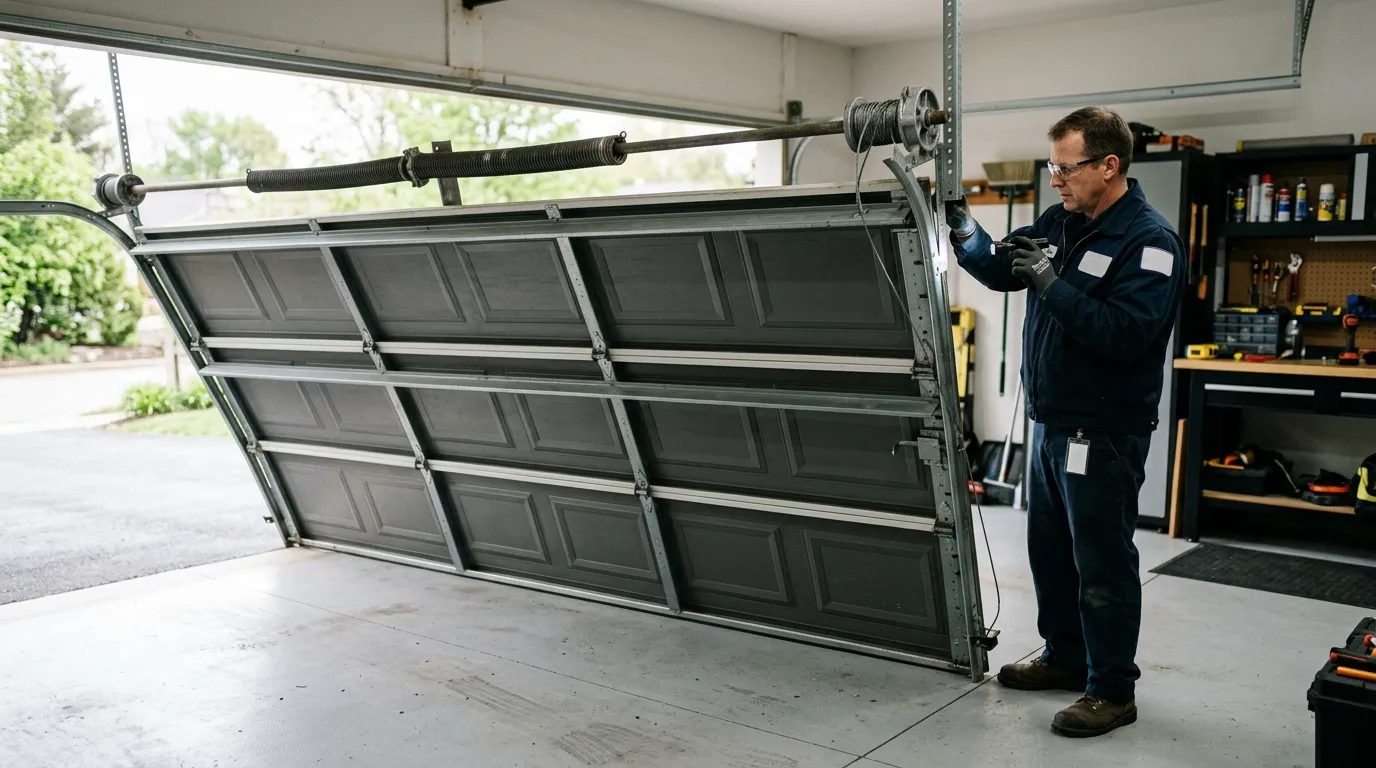
Most homes in Old Bridge went up between 1938 and 2005, with the bulk of the stock dating to the 1960s and '70s. That range matters because it decides what's actually on your header wall. On a service call we start with the spring - torsion or extension, and whether it's the original setup or a replacement someone bolted on later. Then the track: on older houses the vertical track brackets were often shimmed by hand, and decades of settling can throw the whole rail out of plumb by a quarter inch, enough to bind a roller every cycle.
We check cable fraying at the bottom bracket, since that's where road salt and moisture collect over a New Jersey winter. We check the opener's force settings - a lot of openers in this area were adjusted once at install and never touched again, which means the auto-reverse safety feature may not trip the way it should. We look at the panels themselves for rust bubbling at the seams, more common on doors from the earlier end of that 1938-2005 build window. None of this is a guess; it's the order that actually finds the failure, because guessing wastes your time and ours.

The area
What Most People Get Wrong
The most common mistake is spraying WD-40 on a noisy roller and calling it fixed. That's a solvent, not a lubricant - it strips what grease is left and the noise comes back worse in a week. What the rollers on a 1960s or '70s track actually need is a lithium or silicone-based grease, applied to the roller stem, not the track itself.
Second mistake: adjusting spring tension without knowing the door's weight, which on older solid-panel doors from that era can run heavier than the lightweight steel doors sold today. Cranking a torsion spring to compensate for a sagging cable, instead of fixing the cable, just moves the failure point somewhere else.
Third, and this one's specific to houses built before the 1970s changed how garages were wired: people assume the opener's safety sensors are original when the opener itself has been swapped once or twice since the house was built. If the sensors sit at different heights or aren't aligned, the door will reverse for no reason you can see, and no amount of lubricant fixes that. We tell people this even when it means a shorter invoice, because a five-minute sensor realignment beats a return visit.
What we find
What the Weather Here Does to It
Old Bridge sits in a severe cold climate band, and that's not a minor detail for a garage door - it's the reason winter calls spike. Steel contracts in real, measurable ways once temperatures drop hard, and a torsion spring tensioned in July can bind or over-tighten by January. That's not a defect, it's physics acting on hardware that was never adjusted for the swing.
Freeze-thaw cycling is the other half of it. Moisture works into nylon rollers and wood jambs during the melt, then refreezes and expands the crack a little more each time. On houses from the 1960s-70s stock that make up most of this area, wood jambs are original in a lot of cases, and that's where you'll see the door start to bind at the top corners first, not the bottom.
Condensation on the track itself is a smaller but real issue - a cold steel track in a heated-adjacent garage sweats, and that moisture plus road salt tracked in from the driveway is a fast route to a rusted roller bearing. None of this is unique to any one house; it's what a severe cold rating does to any door left unadjusted for more than a season or two.
How we work
What Is Going On
Across the towns we cover - the household count in this service area runs over 313,000, most of them owner-occupied - the pattern is consistent: doors fail in clusters tied to build era, not randomly. A service call is really a diagnosis first. We're checking whether what's in front of us is a fifteen-minute adjustment or a part that needs ordering.
Here's the honest limitation: some hardware from houses at the older end of that 1938-2005 range is discontinued. If your track bracket or a specific spring size isn't something we carry on the truck, that's a lead-time item, not a same-day fix, and we'll tell you that up front rather than stall you with a temporary patch that fails again in a month.
With median household income in this area around $122,610, most owners we talk to want a straight answer on repair-versus-replace rather than a sales pitch either direction. If a 1960s door has three failing systems at once - spring, cable, and a warped panel - replacement usually costs less over time than three separate service calls. If it's one clean failure, we fix that one thing and leave the rest alone.
Questions
Common questions
How do I know if my Old Bridge home has the original garage door hardware?
If your house was built in the 1960s or '70s - common for this area - and the door hasn't been replaced, there's a decent chance the torsion spring and track brackets are original or close to it. A tech can tell in a few minutes by checking the spring's winding cone style and the bracket mounting pattern.
Why does my door bind more in the winter?
Old Bridge sits in a severe cold climate band, and steel contracts as temperatures drop. A spring tensioned for summer weather can bind under winter cold, and moisture from freeze-thaw cycling swells wood jambs and cracks aging rollers. It's seasonal, not a sign the door is broken.
Is it worth fixing an old wood jamb or should I replace it?
Depends on how far the rot or cracking has gone. If it's surface-level from freeze-thaw moisture, a repair holds. If the jamb has shifted enough to throw the track out of plumb, patching it usually fails again within a season and replacement is the better spend.
Do you carry parts for older discontinued door models?
Not always on the truck. Some hardware from the earlier end of the 1938-2005 build range in this area is no longer made, and those parts can mean a short lead time rather than a same-day fix. We'll tell you that during the visit, not after.
Ready when you are
Need a garage door sorted in Old Bridge?
Old Bridge Garage Door Pros repairs and installs garage doors, springs and openers in Old Bridge, NJ and the surrounding area.