
Guide
Is Your Old Bridge Garage Door Worth Fixing
Old Bridge homes mostly date to the 1960s and 70s, with some stock back to 1938. Here's how to tell if that original door is worth repairing or replacing.
Local detail
What to Check
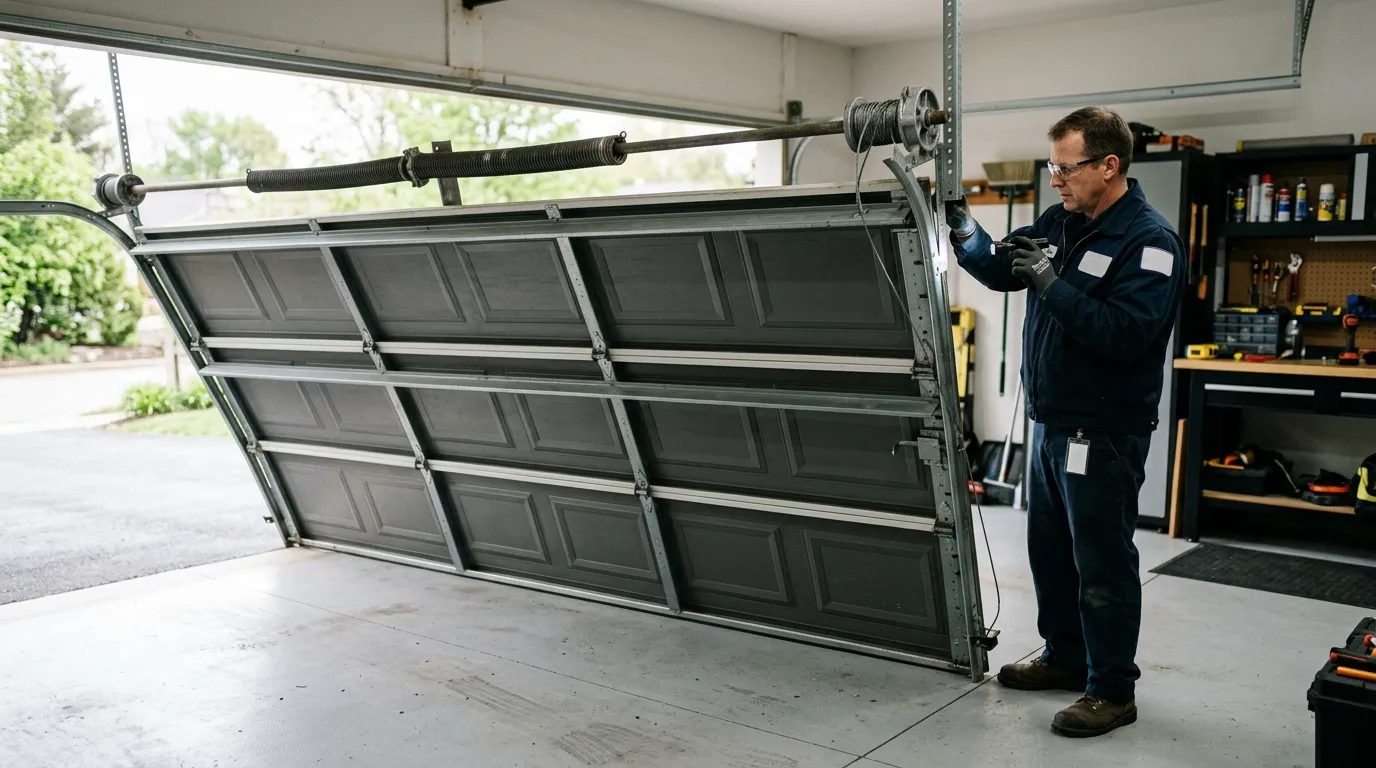
Start with the track and the hardware, not the panel. Most houses in this area went up between 1938 and 2005, with the bulk of the stock from the 1960s and 70s, so a lot of doors we look at are original or close to it. Check the track for rust pitting where it bolts to the jamb - on a house from that era the jamb wood has usually shifted a little over sixty years, and the track bolts loosen before anything else fails.
Look at the bottom panel for water staining on the inside face; a door that's been through decades of Jersey winters usually shows it there first, not on the painted outside. Spin the torsion spring cone by hand if you can reach it safely - original springs from a 1960s or 70s install are long past their rated cycle count and often the first thing to go. If the opener is a chain-drive unit bolted to the same ceiling bracket as the original door, that's a second sign this is an old-house setup, not a newer build.

The area
What Most People Get Wrong
People assume a noisy door means a dying door, and that's backwards more often than not. On the older housing stock around here - median build year 1965 - the noise is almost always rollers that were never replaced, not a structural problem with the door itself. Swapping steel rollers for nylon ones on a door that's otherwise sound is a small job, and it gets skipped because homeowners think the whole unit needs to go.
The other mistake: assuming a door built before 2000 can't take a new opener. It can, as long as the panel and track are square. What actually kills these older doors is neglect of the spring, not age of the panel - a steel panel from 1975 can easily outlast three openers if the spring and hardware get serviced instead of ignored until they snap.
What we find
What the Weather Here Does to It
This area sits in a cold, severe winter climate band, and that matters more for an old door than a new one. Steel panels from the 1960s and 70s weren't insulated the way current doors are, so on a cold morning the metal contracts and any hairline crack in the seam widens a little more each freeze-thaw cycle. That's why panel seams on older doors here split at the bottom corner first - it's the spot furthest from the frame's slight give.
Torsion springs also lose tension faster in sustained cold, which means an old, already-fatigued spring on a house with original hardware is working harder in January than it was rated for even when new. If your door struggles to open on the coldest mornings and moves fine by afternoon, that's the cold exposing a spring that was already near the end, not a new problem.
How we work
What Is Going On
When we get called out to a house built in the 1938-2005 range, we're usually looking at one of two situations: hardware that's tired but the door itself is fine, or a panel that's actually failed and dragging the whole system down with it. The first case is worth fixing every time - new rollers, a new spring, maybe new cables, and the original steel panel keeps going. The second case is harder to call. If the bottom panel has rusted through or the seams have split in more than one spot, you're patching a door that will keep failing every winter, and at that point the labor to keep chasing repairs starts costing more than a new door would.
We won't tell you to replace a door that just needs a spring and some rollers - that's an easy save. But we also won't keep billing you for repairs on a panel that's structurally done. Honest answer: sometimes we can't tell until we're standing in front of it.
Questions
Common questions
How do I know if my garage door is original to the house?
If your house was built in the 1960s or 70s, which covers most of this area, and the door has never been replaced, look for a single steel layer with no foam backing and exposed torsion hardware mounted directly to the header. That combination usually means original equipment from that build era.
Does the cold really affect an old garage door that much?
Yes. This area sits in a cold, severe winter band, and uninsulated steel panels from older builds contract in freezing temperatures. That contraction stresses seams and springs that are already fatigued, which is why older doors tend to act up specifically on the coldest mornings.
Is it ever cheaper to just replace an old door instead of fixing it?
Sometimes. If the panel has rusted through or split at more than one seam, repeated repairs cost more over time than replacement. If the panel is sound and it's just hardware - springs, rollers, cables - fixing it is almost always the better move.
Ready when you are
Need a garage door sorted in Old Bridge?
Old Bridge Garage Door Pros repairs and installs garage doors, springs and openers in Old Bridge, NJ and the surrounding area.