
Guide
Why Your Door Jumped the Track
Old Bridge homes built mostly in the 1960s and 70s came with hardware that wasn't made for hard winters. Here's what actually knocks a door off track around here.
Local detail
What to Check
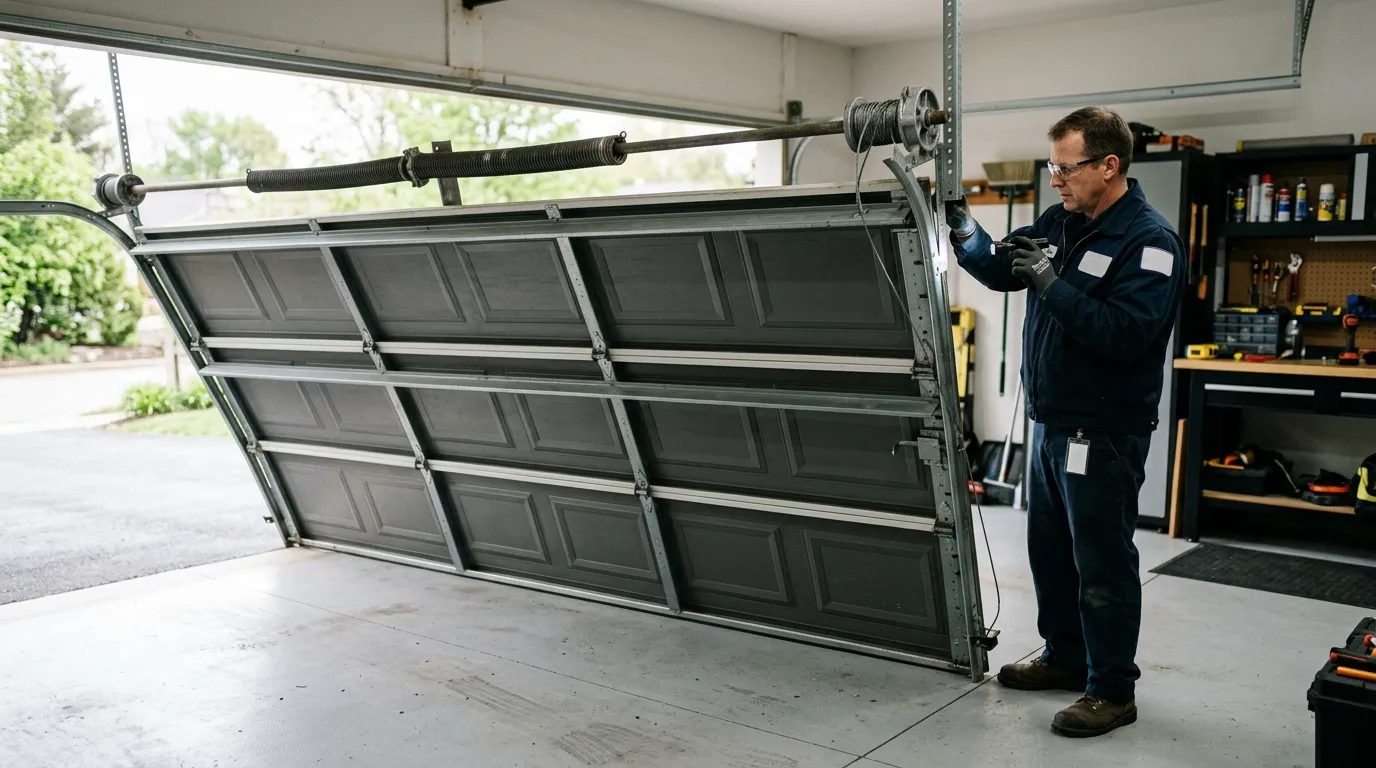
Start at the rollers. On a house from the 1960s or 70s stock that makes up most of this area, the tracks are original-spec steel, narrower than what's sold today, and a roller that's worn even a little will walk right out of that channel. Look at the horizontal track where it meets the vertical section near the top - that bend is where a bracket loosens first, and once it shifts even a quarter inch the door binds against one side going up.
Check the cable on the side that's giving trouble. If it's frayed or has come off the bottom bracket drum, the door will pull unevenly and climb one track faster than the other, which pops it loose at the top. Also look at the track mounting screws where they go into the framing - on houses built before the 1990s that framing has often shifted slightly over sixty-plus years, and screws back out a sixteenth of an inch at a time until the track has play in it nobody notices until the door jumps.
Don't try to force the door back onto the track yourself with the opener still connected. Disconnect the opener arm first. A door under spring tension that's off track is not something to muscle by hand.

The area
What Most People Get Wrong
The common mistake is assuming a bent track caused the problem when the track is usually just a symptom. On this housing stock - median build year 1965 - most doors have had at least one hardware swap by now, and mismatched parts are common: a newer roller in an old track, or a replacement bracket that's a slightly different gauge than the original. None of that is wrong by itself, but it changes the tolerances the track was built around, and a small hit or a season of cold contraction is enough to walk it off.
People also chase the spring when the real issue is a broken or badly worn roller on the opposite side. If one side of the door is riding low, the door tips as it travels, and the high side pops off the track at the first bend. Replacing the spring won't fix that.
The other thing owners get wrong is waiting. A door that's briefly off track and gets forced back into a rough approximation of running is a door that will do it again, usually worse, because the track is now bent from the first event. Once a track has a kink in it, straightening it rarely holds - it needs to be swapped, not hammered back into shape.
What we find
What the Weather Here Does to It
This area sits in a severe cold climate band, and that matters more for door tracks than most people expect. Steel track contracts in a hard freeze, and on hardware installed decades ago - a lot of it original to houses built in the 1938 to 2005 range - the fasteners have already lost some grip from age. Add a cold snap that shrinks the metal and you get just enough play at the mounting points for the door to walk sideways on its way up.
Ice is the other factor. Moisture that gets into the track and freezes overnight adds resistance right at the bottom, where rollers are already working hardest. A door pulling against a patch of ice in the track puts uneven load on both sides, and that's a common way a door pops loose right at the bottom bracket on a cold morning.
We don't recommend de-icer sprays on the track - most of them degrade the lubricant on the rollers faster than they solve the ice problem. A dry cloth and patience does more good on a frozen track than anything from a spray can.
How we work
What Is Going On
Put together, a door off track in this area is almost always one of three things: a worn roller that's let the door tip, a loosened bracket where decades-old fasteners have given up their grip, or a track that's picked up a slight bend from cold-weather contraction plus age. None of these are dramatic failures - they're slow ones, which is why the door usually runs fine for months and then comes off track on one particular cold morning.
We don't push full track replacement on doors where a bracket tightening and a roller swap will do the job - that's not always the fix, but on hardware this old it's the first thing worth checking before assuming the whole track needs to come out. If the track itself is bent, though, straightening it is a temporary patch at best. It goes back to the same weak spot within a season.
Questions
Common questions
Why did my garage door suddenly come off the track this winter?
Most likely a cold-weather contraction issue meeting hardware that's already loose from age. Old Bridge sits in a severe cold climate zone, and steel track that's decades old - common on houses built here in the 1960s and 70s - has less give left in the fasteners. A hard freeze is often the final push, not the root cause.
Can I push the door back onto the track myself?
Disconnect the opener first, but don't force a spring-loaded door back into place by hand. If the track has a bend in it, pushing the door back on will only reload the same weak spot. It's worth having someone look at whether the track needs replacing before you run the door again.
Is a bent track always the cause of the problem?
No. A bent track is often a symptom of a worn roller on the opposite side, which tips the door as it travels and pops the high side loose. On older hardware, checking the rollers before replacing the track saves a job that isn't needed.
Ready when you are
Need a garage door sorted in Old Bridge?
Old Bridge Garage Door Pros repairs and installs garage doors, springs and openers in Old Bridge, NJ and the surrounding area.